GoodFirms began with an idea: help businesses discover the right software and technology service providers. But turning that idea into a global marketplace required much more than generating traffic. The platform needed a brand people could understand, a product experience people could use, technology that could scale, content people could trust, a community willing to participate, acquisition systems that could create demand, and monetization strategies that could turn the ecosystem into a sustainable business. SignalScaler worked across these layers. The result was a growth ecosystem built from the ground up.
The Challenge
The real challenge was turning that idea into a trusted, discoverable and commercially sustainable platform.
There were two audiences to solve for. Buyers needed a trustworthy way to discover and evaluate software and technology providers. Companies needed a credible platform where they could establish their presence, showcase their capabilities and reach potential buyers. There was no established audience to simply acquire — the platform needed companies, products, reviews, useful content, search visibility, buyer engagement, provider participation and revenue, all reinforcing each other at once.
The real problem
"Why would people search for a platform they didn't know existed? The challenge wasn't simply generating traffic — it was building the ecosystem that would make the traffic, participation and revenue possible."
The Strategic Insight
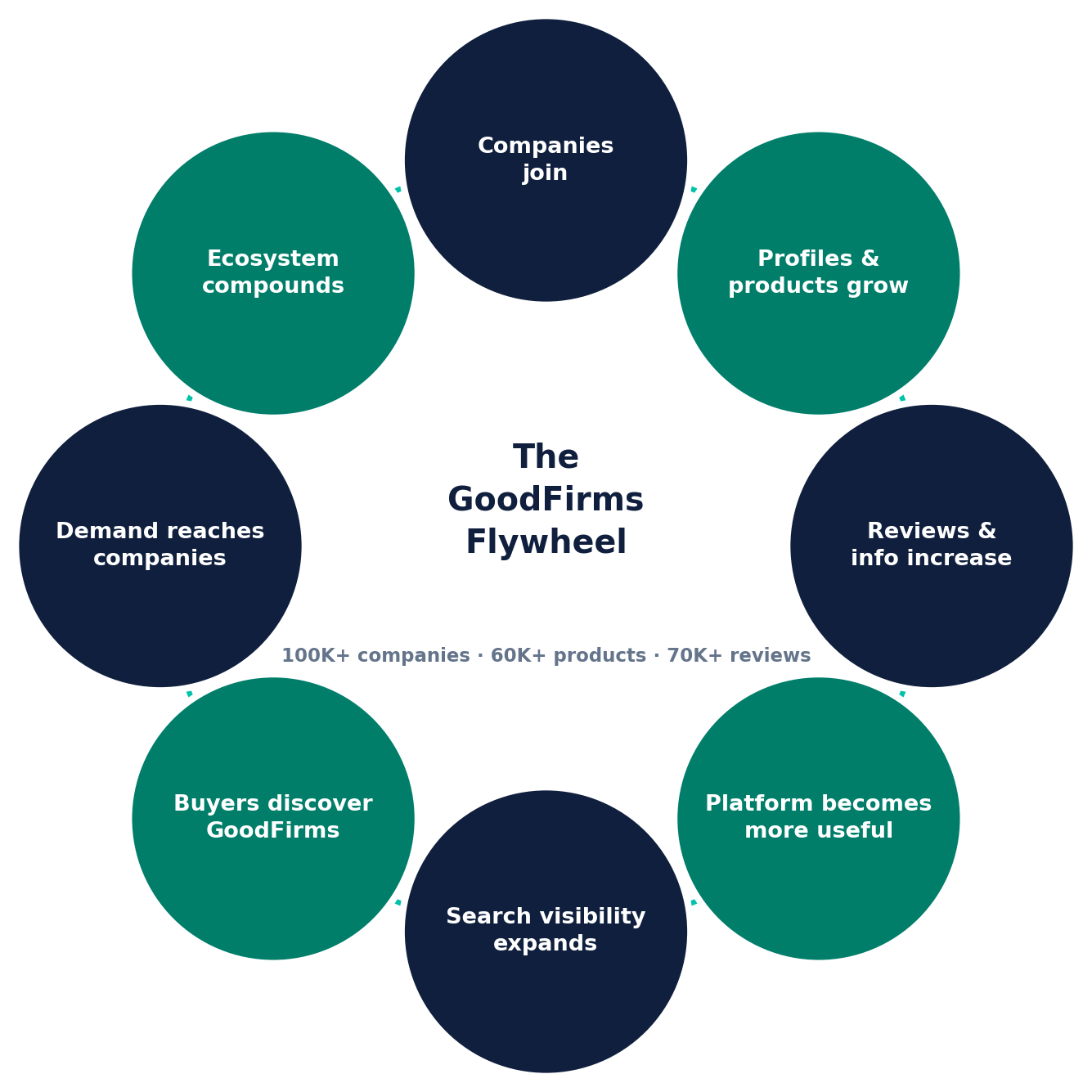
Rather than treating SEO as a standalone marketing channel, we approached GoodFirms as a connected digital ecosystem. The strategy was built around one core principle: make the platform genuinely useful — then make it discoverable. That meant creating value for both sides of the marketplace — better discovery, comparisons and decision-making for buyers; greater visibility, credibility and reach for companies. As the ecosystem became more valuable, it created a powerful growth loop: value creates participation, participation creates content, content creates discovery, discovery creates traffic and demand, demand creates monetization — and monetization funds more value.
The core principle
"We didn't build a traffic channel. We built a growth system."
The End-to-End Approach
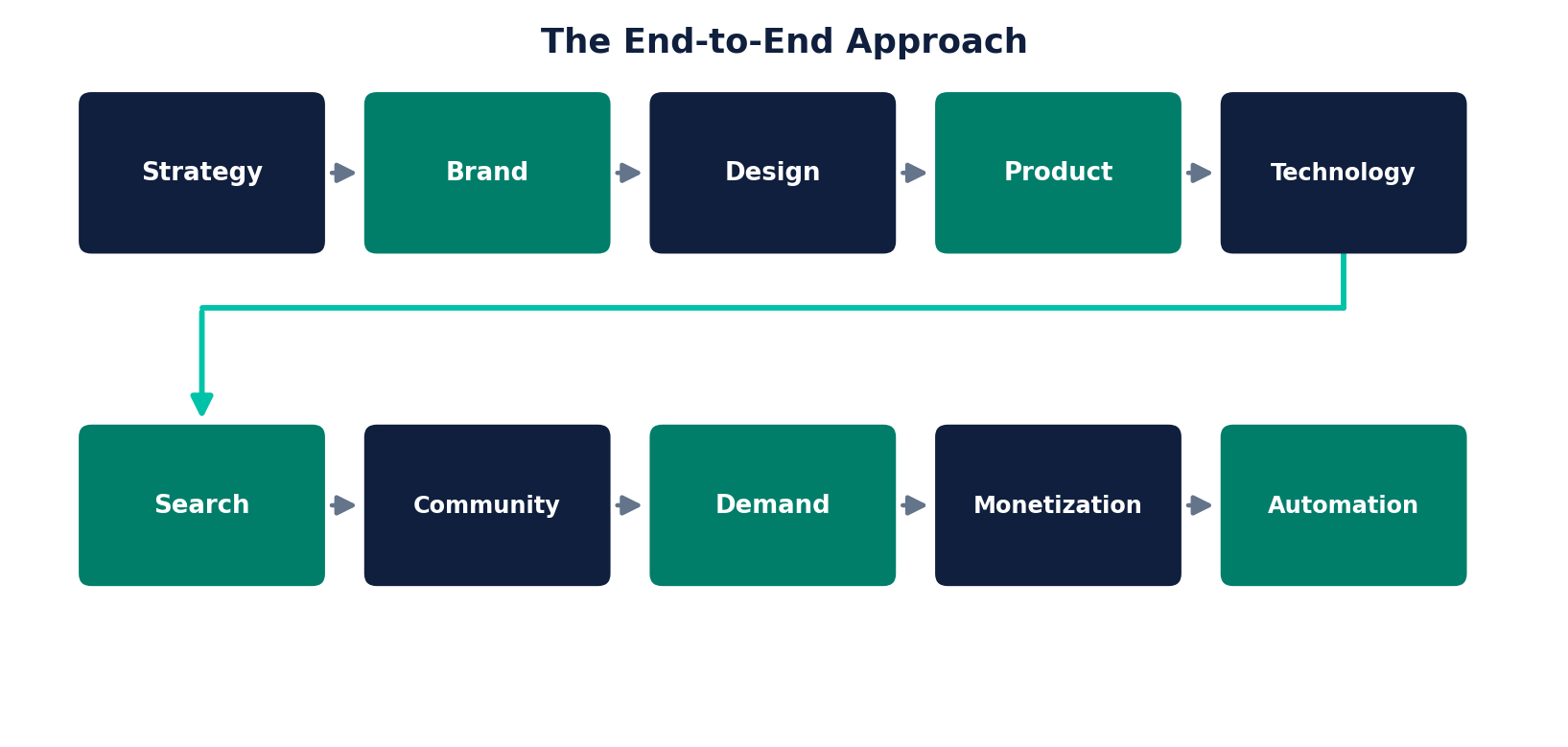
The work went beyond marketing execution. Strategy, brand, design, product, technology, search, community, demand, monetization and automation were treated as interconnected parts of the same business problem — not ten separate services.
The System — How It All Connected
Each part of the system fed the next.
01 — Business & Growth Strategy
Deciding where to compete and who to serve
Market positioning, audience definition, buyer and provider journeys, category strategy, acquisition strategy and long-term marketing architecture — establishing where GoodFirms should compete and how the ecosystem could grow.
02 — Brand Positioning & Messaging
Making a complex marketplace understandable, fast
Brand positioning, value proposition, messaging and information hierarchy — built so the brand promise, product experience and marketing message told the same story to both buyers and companies.
03 — Design & User Experience
Turning a complex marketplace into a usable experience
Design was approached around information architecture, category discovery, navigation and conversion paths — not decoration. Every major interaction had to help users understand, discover or act.
04 — Building the Digital Platform
The website was only the front door
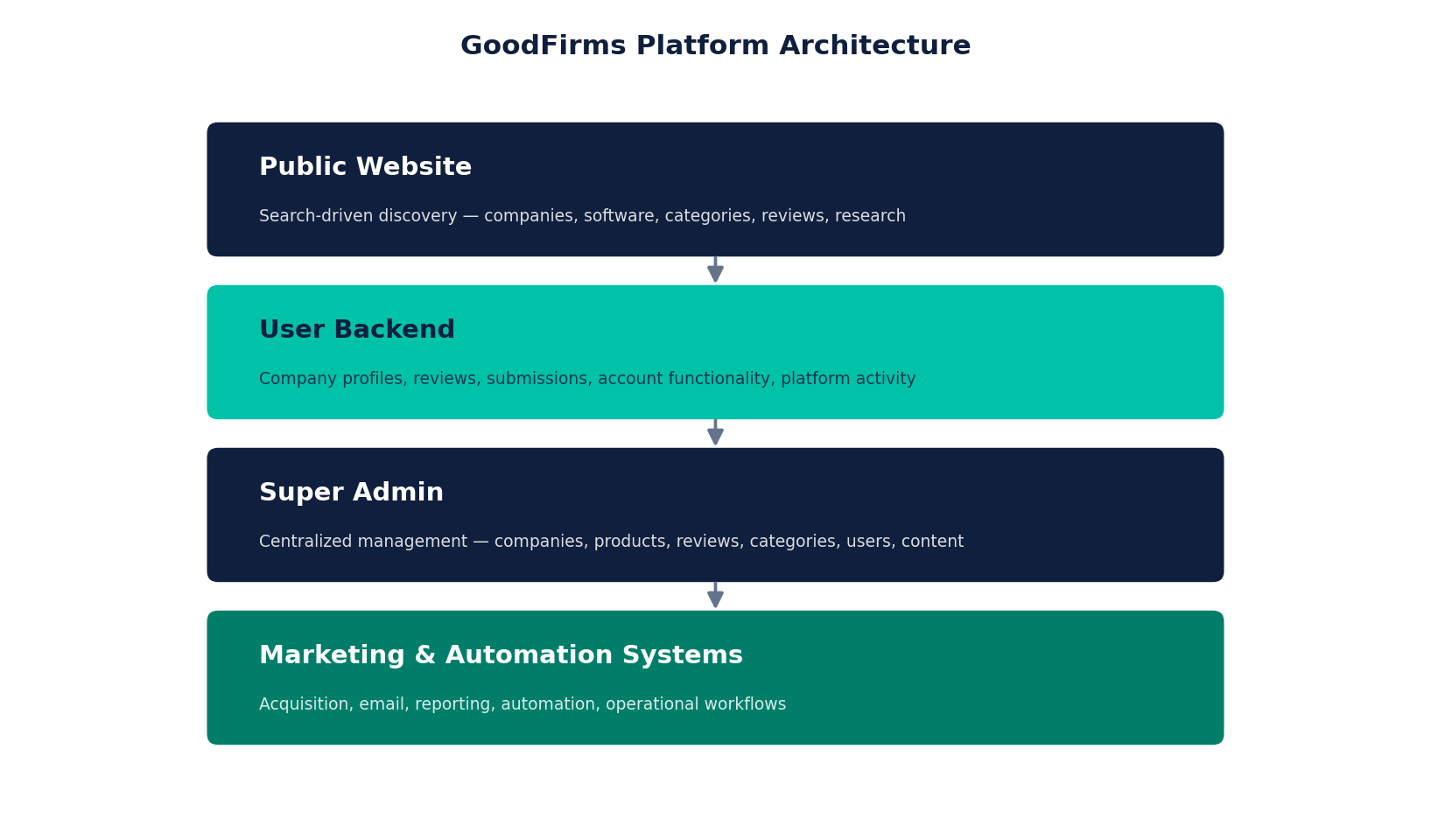
Behind the public-facing website was a much deeper system: a public search-driven website, a user backend supporting company profiles and reviews, and a super admin system for managing the growing ecosystem of companies, products, reviews and operations — connected to acquisition, email, reporting and automation workflows.
Built for Growth. Engineered for Search.
SEO wasn't added after development — it was a design constraint from day one. As the number of companies, products, reviews and content pages grew into the tens of thousands, the platform's technical foundation had to support that scale without breaking.
Information & URL Architecture
A structure that could keep growing
Scalable category and sub-category architecture, clean and consistent URL patterns across companies, products and services, and proper canonicalization to prevent duplicate-content issues as thousands of near-identical listing pages were added.
Crawlability & Indexation
Making sure search engines could actually find everything
Structured internal linking between category pages, company profiles and content, clean sitemap architecture, and search-friendly page templates — so new listings and reviews got discovered and indexed quickly rather than sitting invisible to Google.
Structured Data
Giving search engines the context to understand the marketplace
Schema markup applied across company profiles, product listings and reviews, so search engines could understand and surface ratings, review counts and category relationships directly — not just crawl plain text.
Performance & Mobile
Speed and usability at real scale
Page performance and mobile usability treated as ranking-relevant, not cosmetic — with tens of thousands of pages live, small per-page inefficiencies compound into a real crawl-budget and user-experience problem.
05 — Building the Organic Search Engine
From individual keywords to an entire search ecosystem
Content and page architecture were built around how buyers actually searched — category pages, company profiles, comparison content and buyer guides — covering queries like "best CRM software" and "top mobile app developers" at every point in the buyer journey.
Building the Community
A marketplace becomes more valuable as more people and businesses contribute to it. Starting from scratch, the ecosystem grew to include 100K+ companies, 60K+ products and 70K+ reviews. More participation created more value. More value created more discovery. More discovery created more participation.
Turning the Ecosystem Into Revenue
Traffic was not the end goal — the platform needed to become a sustainable business. The monetization strategy evolved alongside the platform, built around company visibility, premium presence, lead-generation opportunities and buyer-intent advertising. The important principle: monetization had to grow with the ecosystem rather than compromise the value of the platform.
From $0 to $300K/month
$300K
Peak monthly revenue during the engagement
This wasn't the result of one campaign or one channel — it was the outcome of building multiple connected growth systems around the platform. The section below covers what those systems actually were.
Beyond SEO: Building Demand
SEO was the foundation, but the business was supported by a broader demand-generation system running alongside it.
Email
Nurturing both sides of the marketplace
Buyer newsletters, company communication, review-request campaigns, registration campaigns, list segmentation and lead nurturing sequences — run continuously, not as one-off blasts.
Paid Acquisition
Capturing high-intent demand organic hadn't reached yet
Google Ads targeting high-intent category queries, remarketing to warm visitors, landing-page optimization and continuous testing — complementing organic rather than replacing it.
Outreach
Growing the marketplace's other side
Direct company acquisition, encouraging platform participation, review generation and relationship building with the providers who make the marketplace valuable in the first place.
Automation
Making growth operationally sustainable
Registration workflows, review-request automation, email automation, reporting and operational workflows — so growth didn't depend on manual effort scaling linearly with the ecosystem.
From Zero to Scale
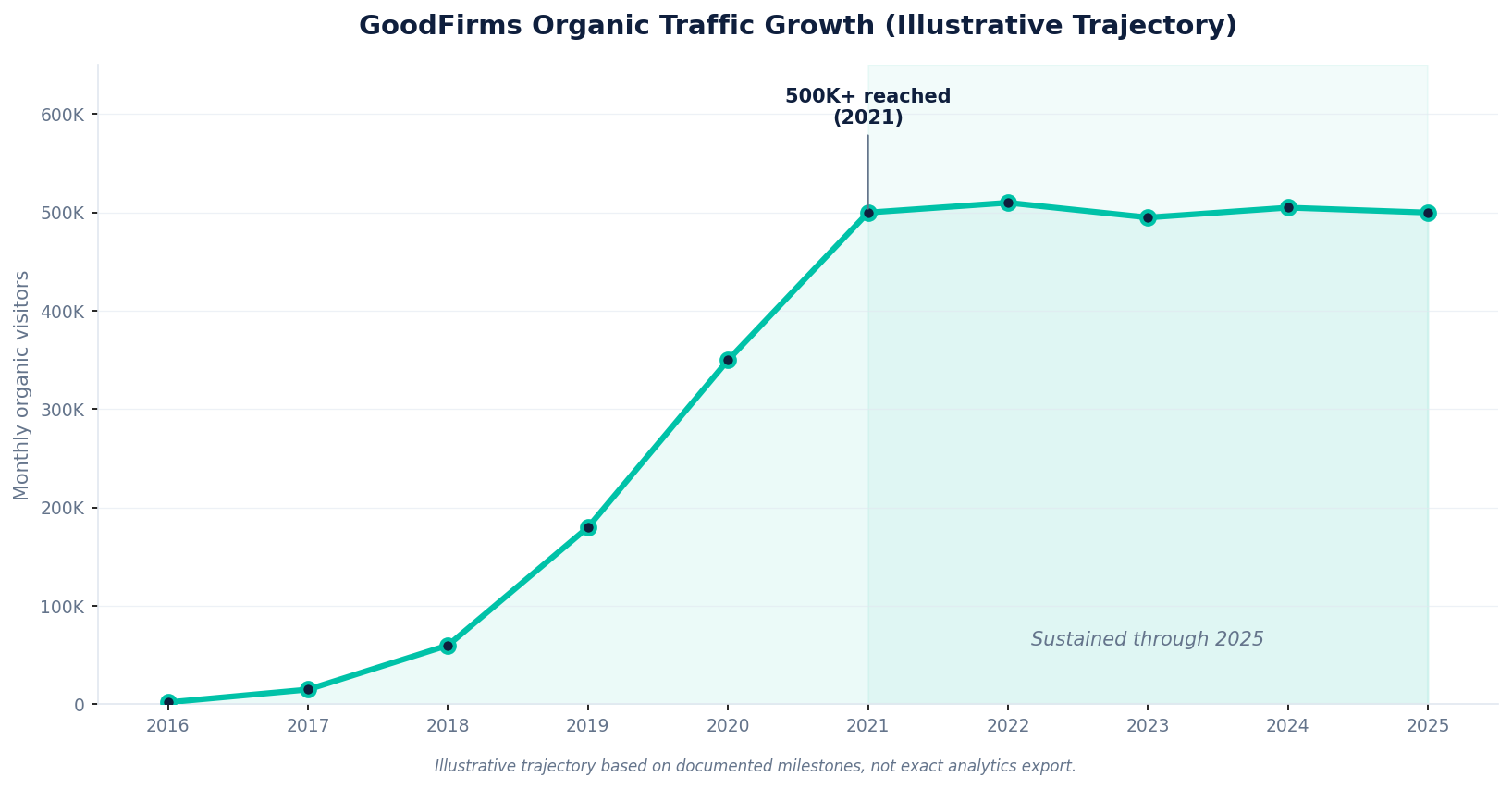
GoodFirms didn't reach 500K+ monthly visitors through one campaign — it moved through a clear progression, each stage building the foundation for the next.
Reaching — and Sustaining — 500K+ Monthly Visitors
After building the foundation, expanding the platform and scaling acquisition, GoodFirms reached 500K+ monthly organic visitors by 2021. But reaching 500K wasn't the final objective — the harder challenge was keeping it. The years through 2025 were focused on continuously adapting to search algorithm changes, increasing competition and evolving technical requirements. 500K+ monthly organic traffic was sustained through 2025, demonstrating the durability of the underlying system.
Preparing for the next generation of search
The principles that supported traditional SEO — clear information architecture, authoritative content, structured data and useful answers — became increasingly important as search moved toward answer-driven and generative experiences. SEO: be discoverable. AEO: be useful enough to become an answer. GEO: be authoritative enough to become a source. Different expressions of the same principle: build information people and search systems can trust.
What Made the Model Work
- Product and marketing worked together — the product experience itself supported acquisition and conversion
- SEO was built into the architecture, not added as an afterthought
- Community created compounding value — every new company, product and review made the platform more useful
- Monetization followed ecosystem growth rather than compromising it
- Systems replaced manual growth as the business scaled
- The milestone was sustained — reaching 500K mattered, but maintaining it through 2025 was the proof of durability
What We Learned
1
Don't start by asking "how do we get more traffic?"Ask what would make people want to come here — once the product, content and ecosystem create genuine value, acquisition becomes far more powerful.
2
Don't treat SEO as a marketing layer.For a marketplace, SEO can become part of the product itself — information architecture, category structure and content all contribute to discoverability.
3
Don't build an audience without a business model.Traffic becomes significantly more valuable once you understand how participation, demand and monetization connect.
4
Don't optimize one channel.The strongest growth happens when product, brand, technology, SEO, community, demand and monetization work as one system.
5
Reaching scale is only half the job.Sustaining scale proves the strength of the system — a milestone hit once is a spike; a milestone held for years is a system that actually works.
The Results
From a concept to a global growth ecosystem
500K+
Monthly organic visitors — reached 2021, sustained through 2025
$300K
Peak monthly revenue, grown from $0
100K+
Companies built into the platform ecosystem
60K+
Products in the software discovery ecosystem
70K+
Reviews building trust and participation
150+
Countries reached, organic only
Strategy. Design. Technology. Growth.
SignalScaler worked across the business-building lifecycle, not as a channel-specific marketing vendor.
S
StrategyWhat should we build and where should we compete?
B
BrandHow should the market understand and remember it?
D
DesignHow should the experience communicate that promise?
T
TechnologyHow should the system scale?
S
SEOHow should people discover it?
C
CommunityHow do we create participation and trust?
D
DemandHow do we turn discovery into business opportunities?
M
MonetizationHow does the ecosystem create revenue?
A
AutomationHow does the system continue operating at scale?
GoodFirms evolved from a platform that needed to create awareness into an ecosystem that could increasingly generate its own momentum. The result wasn't just 500K monthly visitors — it was a self-reinforcing growth ecosystem.
One channel doesn't build a business. A system does.
GoodFirms proves it — strategy, design, technology, search, community and monetization working as one connected system, not eleven separate services. If your growth has stalled, that's usually where the real gap is hiding.