Last updated September 2026

Make AI Agents for SaaS Teams

Make's 2026 AI Agents bring judgment-based automation directly into its visual scenario builder -- a real capability, built on the same platform you may already be running.

Quick answer: A Make AI Agent can decide what to do mid-scenario based on context, not just a fixed condition -- similar to Zapier's AI Agents, but inside Make's visual builder, which tends to make the surrounding logic easier to see and adjust. It's genuinely useful for bounded, well-defined tasks; for deep AI orchestration with multiple chained models, n8n still offers more control.

Is This the Right Fit?

We'd rather tell you honestly than sell you AI for its own sake.

Good fit if
  • You're already running scenarios in Make and want to extend one with a judgment step, not rebuild your stack
  • The decision is bounded and well-defined -- classify, route, or draft, not open-ended reasoning
  • You value being able to see the surrounding logic visually while building
  • You're comfortable with AI Agent runs costing more of your operation allowance than a standard module
Consider n8n instead if
  • You need to chain multiple models together, or want custom memory/context across steps
  • You want the lowest possible cost at real volume -- n8n's self-hosted option has no per-execution AI-adjacent cost
  • The task genuinely needs deep, LangChain-style orchestration, not a single judgment call

The cost most people don't check upfront

An AI Agent step involves an underlying model call, which typically consumes more of your operation allowance than a standard module. It's a real, predictable cost -- worth factoring into your plan tier before you build, not after the bill arrives.

What We Build

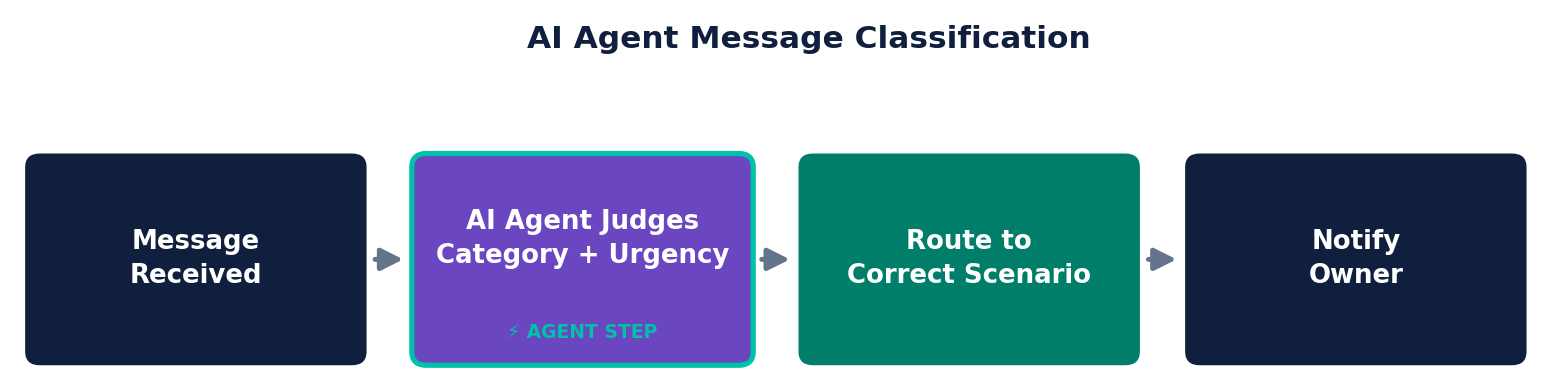
AI Agent message classification workflow in Make -- message received, AI Agent judges category and urgency, routes to the correct scenario, notifies owner
Inbound message classification
An Agent reads an incoming message and decides its category and urgency, routing it to the right scenario branch automatically -- no fixed keyword rules to maintain.
Context-aware data enrichment
Beyond a simple lookup -- an Agent weighs several signals together and decides what additional context is worth attaching to a record before it moves downstream.
Draft generation with human review
An Agent drafts a response or summary based on scenario context -- a person still reviews before it goes out, but the first draft is already done.
This sits on top of the same Make foundation as everything else we build. See our full Make Automation Consulting page for the platform-level details, or our n8n vs Zapier vs Make comparison if you're still deciding which platform fits.

Every implementation starts with the same process we use for everything — audit first, then build what the audit actually finds, not the other way around.

Frequently Asked Questions

How do Make's AI Agents compare to Zapier's?

Conceptually similar -- both let a step make a judgment call mid-workflow rather than following a fixed path. Make's visual scenario builder tends to make the surrounding logic easier to see and adjust, while Zapier's catalog of app integrations is broader.

Is Make or n8n better for complex AI orchestration?

For straightforward autonomous decisions, Make's native AI Agents are faster to set up. For genuinely complex AI orchestration -- chaining multiple models, custom memory, deep LangChain-style integration -- n8n's AI nodes offer more depth and control.

Do Make AI Agent runs cost more than standard scenarios?

Yes -- an AI Agent step involves an underlying model call, which typically consumes more of your operation allowance than a standard module. We factor this into the plan-tier conversation upfront.

What tasks are a good fit for a Make AI Agent?

Bounded, well-defined judgment calls -- classifying an inbound message, deciding which of a few known paths to take based on context. High-stakes or highly ambiguous decisions still deserve a human in the loop.

Not sure if an AI Agent fits your scenario?

That's exactly what a Discovery Call is for — an honest look at whether autonomy actually helps here before we recommend anything.

Tell us about your business →
We use cookies to understand how visitors use this site. Analytics cookies stay off unless you say yes — see our Cookie Policy for details.

Cookie Preferences

Strictly Necessary
Required for the site to function. Always on, cannot be disabled.
Analytics
Helps us understand how visitors use the site (Google Analytics). Off by default.