Last updated September 2026
For teams that need self-hosting Make doesn't offer, or have grown past the point where per-operation billing makes sense -- migrating the scenarios that actually justify it, without breaking what's already running.
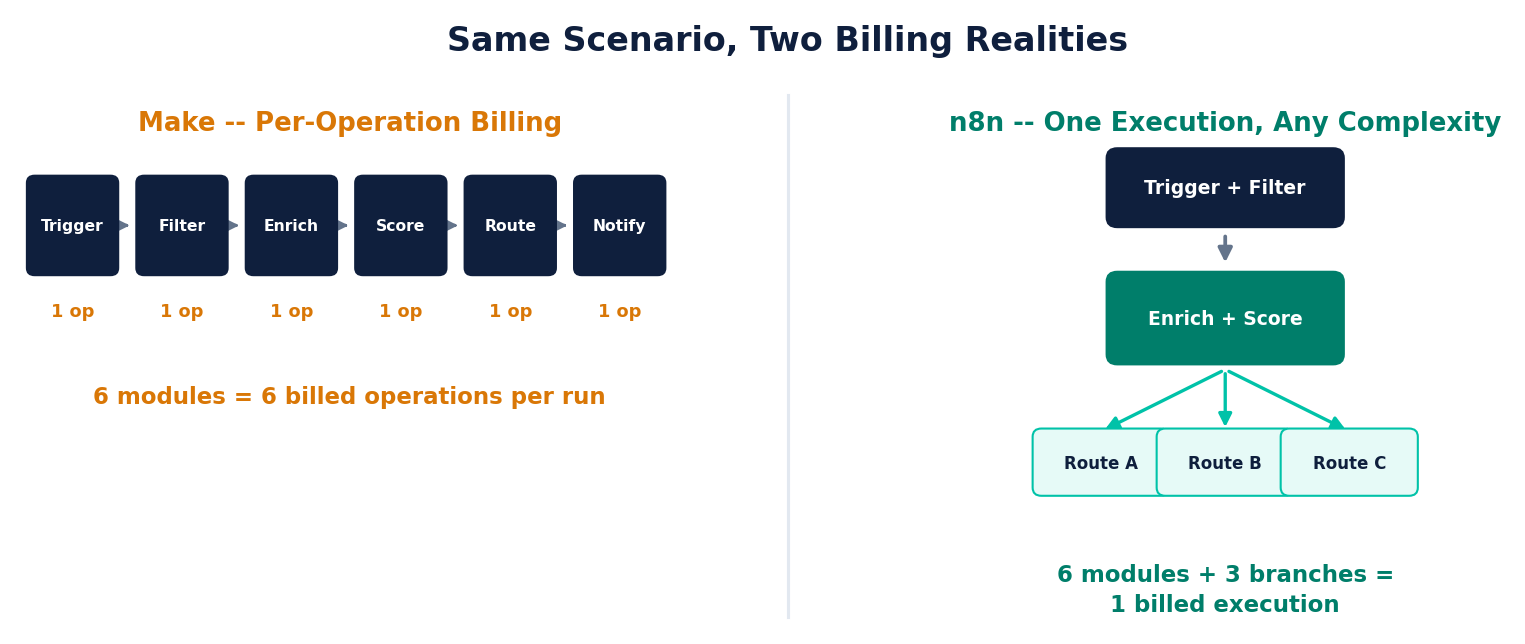
Quick answer: Most Make-to-n8n migrations come down to one of two reasons: needing self-hosted infrastructure for compliance or data residency, or running enough volume that n8n's execution-based pricing beats Make's per-operation billing. There's no direct converter -- each scenario has to be rebuilt -- so a phased migration, moving the highest-value scenarios first, is the lower-risk path.
We'd rather tell you honestly than push a migration you don't need yet.
Make's visual scenario builder is conceptually closer to n8n's node-based canvas than Zapier's linear structure is -- but there's still no direct import. Each scenario's modules, filters, and routing logic get rebuilt as n8n nodes, one workflow at a time. The business process doesn't change; the implementation does. An audit of your active scenarios comes first, so migration effort goes where it actually pays off.
Every migration starts with the same process we use for everything — audit first, then build what the audit actually finds, not the other way around.
The two most common reasons: needing to self-host for data residency or compliance (Make doesn't offer this), or running enough volume that n8n's execution-based pricing becomes meaningfully cheaper than Make's per-operation billing.
No -- there's no direct converter between the two. Each Make scenario's modules and logic have to be rebuilt as n8n nodes. The underlying business process stays the same; only the implementation changes.
Generally similar in effort -- both require rebuilding workflow logic from scratch. Make's visual scenario builder is closer in structure to n8n's node-based canvas than Zapier's linear Zaps are, which can make the conceptual mapping slightly more direct, though the actual build work is comparable.
No. A phased approach -- migrating your highest-volume or most compliance-sensitive scenarios first while the rest keep running on Make -- is the lower-risk path, and lets you validate n8n before committing fully.
That's exactly what a Discovery Call is for — an honest look at your actual Make usage before we recommend anything.
Tell us about your business →