Last updated September 2026

Zapier to n8n Migration

For teams that outgrew Zapier's per-task pricing or hit a branching-logic ceiling it can't handle -- migrating the workflows that actually justify it, in phases, without breaking what's already running.

Quick answer: Most teams migrate when Zapier's per-task billing starts costing real money at volume, or when workflow complexity outgrows Zapier's linear structure. There's no automatic converter -- each Zap has to be rebuilt in n8n -- so migration works best done in phases, moving your highest-cost workflows first while Zapier keeps running everything else.

Is This Migration Right for You Yet?

We'd rather tell you honestly than push a migration you don't need yet.

Worth migrating if
  • You're running enough volume that Zapier's per-task billing is now a real, visible cost
  • You've hit workflows too complex for Zapier's linear Zap structure to handle cleanly
  • You have some technical capacity in-house, or are bringing in help for it
  • Data residency or compliance now requires automation to run on your own infrastructure
Not worth it yet if
  • Your workflows are still simple and low-volume -- the cost difference won't matter yet
  • Nobody can maintain a self-hosted tool, and you don't want that ongoing dependency
  • You rely on a niche integration Zapier supports natively that n8n doesn't have a clean API path to

What actually changes in the migration itself

Zapier and n8n don't share a file format -- there's no import button. Each Zap's underlying logic (the trigger, the conditions, the actions) gets rebuilt as an n8n workflow, node by node. The business process stays identical; only the implementation changes. That's exactly why an audit of your existing Zaps comes first -- to scope what's actually worth rebuilding versus what's simple enough to leave running as-is.

How a Phased Migration Actually Works
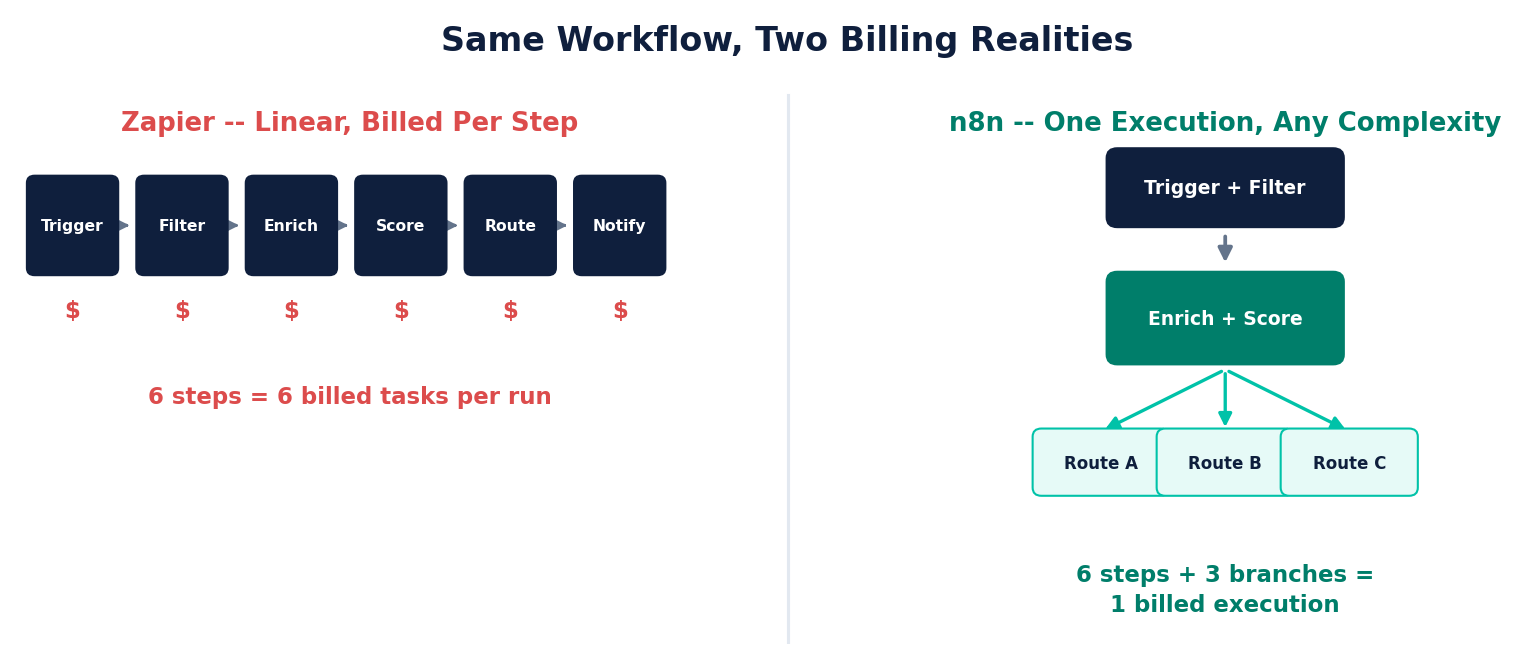
Same workflow shown two ways -- Zapier's linear structure billed per step versus n8n's branching structure billed as one execution
1
Audit your existing Zaps
Every active Zap, ranked by execution volume and cost -- so migration effort goes toward the workflows actually costing you money, not everything at once.
2
Rebuild the highest-value workflows first
Your highest-volume, highest-cost Zaps get rebuilt in n8n and tested in parallel -- running alongside the original Zap, not replacing it yet.
3
Cut over once the n8n version is verified
Only once the n8n workflow has run correctly in parallel do we switch the Zapier version off -- nothing goes dark mid-migration.
4
Repeat for the next tier, leave the rest on Zapier if it makes sense
Low-volume or niche-integration Zaps often aren't worth migrating at all -- a good migration plan says so explicitly, rather than moving everything for the sake of it.
Not sure if the cost difference is big enough to justify migrating? Our n8n vs Zapier vs Make comparison breaks down exactly where the pricing gap starts to matter.

Every migration starts with the same process we use for everything — audit first, then build what the audit actually finds, not the other way around.

Frequently Asked Questions

Can Zapier workflows be automatically converted to n8n?

No -- there's no automatic converter. Each Zap's logic has to be rebuilt as an n8n workflow. The business logic doesn't change, but the implementation does, which is exactly why an audit comes before any rebuilding starts.

Do we need to migrate everything at once?

No, and we'd generally recommend against it. A phased migration -- moving your highest-volume, highest-cost workflows first while lower-priority Zaps keep running -- reduces risk and lets you validate n8n on real workflows before committing fully.

How long does a typical Zapier to n8n migration take?

It depends entirely on how many workflows and how complex the branching logic is. A handful of straightforward Zaps can take days; a large, complex Zapier setup with many interdependent workflows can take several weeks done properly, in phases.

Will our automations stop working during the migration?

They shouldn't -- a properly phased migration keeps Zapier running for workflows not yet migrated, and each n8n workflow is tested before its Zapier equivalent is switched off, not after.

Not sure if migrating is worth it yet?

That's exactly what a Discovery Call is for — an honest look at your actual Zapier costs before we recommend anything.

Tell us about your business →
We use cookies to understand how visitors use this site. Analytics cookies stay off unless you say yes — see our Cookie Policy for details.

Cookie Preferences

Strictly Necessary
Required for the site to function. Always on, cannot be disabled.
Analytics
Helps us understand how visitors use the site (Google Analytics). Off by default.