Last updated September 2026

Zapier Lead Routing for SaaS Teams

Fast, straightforward lead assignment rules -- built in Zapier, in an afternoon, not a project. We'll also tell you honestly the moment you've outgrown it.

Quick answer: Zapier handles lead routing well when the rules are straightforward -- score above X, assign to Rep A; territory match, assign to Rep B. Its Paths feature supports real branching logic. It starts to strain once routing needs many conditions, external data, or genuinely high volume, where per-task billing and Zapier's linear structure both become real constraints.

Is This the Right Fit?

We'd rather tell you honestly than build routing logic on the wrong platform.

Good fit if
  • Your routing rules are straightforward -- a handful of conditions, not dozens
  • You want it working this week, not after a multi-week technical build
  • Lead volume is moderate, not yet at a scale where per-task cost is a real concern
  • Your CRM has a native Zapier integration already
You've likely outgrown it if
  • Routing needs to check external data -- rep availability, territory databases, enrichment APIs -- beyond what a Path can cleanly handle
  • Per-task billing is now a real, growing line item as volume increases
  • You need many conditions or nested logic that starts to feel unwieldy in a linear Zap

Where the cost conversation actually starts

Zapier's Paths feature bills each path as part of the same per-task structure as the rest of the Zap -- more conditions and more branches means more billed tasks per run. For simple, moderate-volume routing this is rarely a real cost. It becomes worth a second look once you're running real volume with multiple conditions checked on every lead.

What We Build

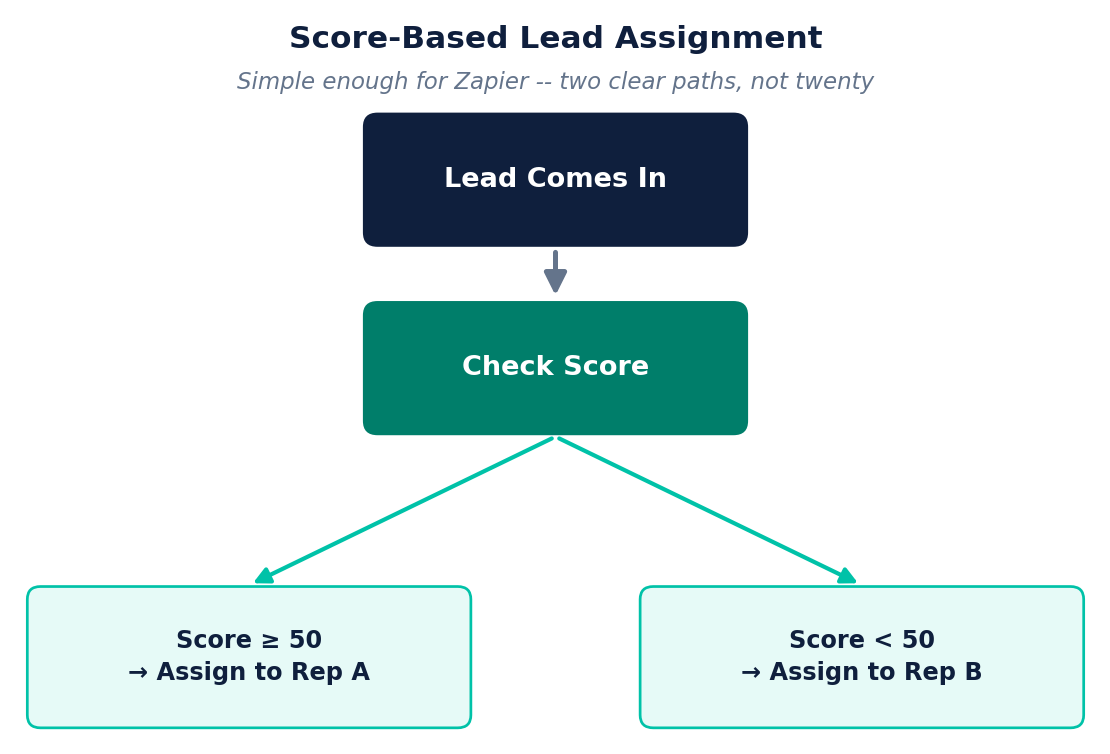
Score-based lead assignment workflow -- lead comes in, score is checked, and it routes to one of two reps based on a simple threshold
Score-based assignment
A lead crosses a score threshold and gets assigned to the right rep or queue automatically -- no manual triage for straightforward cases.
Territory-based routing
Leads route by region or account ownership rules, written directly back to your CRM record.
Round-robin assignment
Even distribution across a sales team without a spreadsheet or manual tracker -- Zapier handles the rotation logic directly.
Outgrown Zapier's routing already? Our n8n Lead Scoring & Routing page covers multi-condition logic and external data checks without per-branch cost. If you're mid-migration, see our Zapier to n8n Migration guide.

Every implementation starts with the same process we use for everything — audit first, then build what the audit actually finds, not the other way around.

Frequently Asked Questions

Can Zapier handle lead routing with multiple conditions?

Yes, for a handful of conditions -- Zapier's Paths feature supports branching logic. It works well for straightforward rules, but each path is still billed per task, and very complex multi-condition routing tends to get expensive and unwieldy faster than on a platform built for it.

How do I know if I've outgrown Zapier for lead routing?

The signals are usually cost (per-task billing adding up at real volume) or complexity (routing rules that need external data beyond what a Path can cleanly check). Either signal is worth a conversation before you build more on top of Zapier.

Does Zapier lead routing integrate with our CRM?

Most major CRMs have native Zapier integrations, so routing decisions can write back to lead records directly without custom API work in most cases.

What happens if we outgrow Zapier later?

Your routing logic migrates, not your CRM data -- the underlying business rules carry over to a platform like n8n, rebuilt to handle more complexity or volume. We cover this directly on our Zapier to n8n migration page.

Not sure Zapier still fits your routing needs?

That's exactly what a Discovery Call is for — an honest look at your actual rules and volume before we recommend anything.

Tell us about your business →
We use cookies to understand how visitors use this site. Analytics cookies stay off unless you say yes — see our Cookie Policy for details.

Cookie Preferences

Strictly Necessary
Required for the site to function. Always on, cannot be disabled.
Analytics
Helps us understand how visitors use the site (Google Analytics). Off by default.